
Core treatments
IASTM (Instrument-Assisted Soft Tissue)
Specialised tools to help break down adhesions and improve stiffness and pain in muscles and fascia.
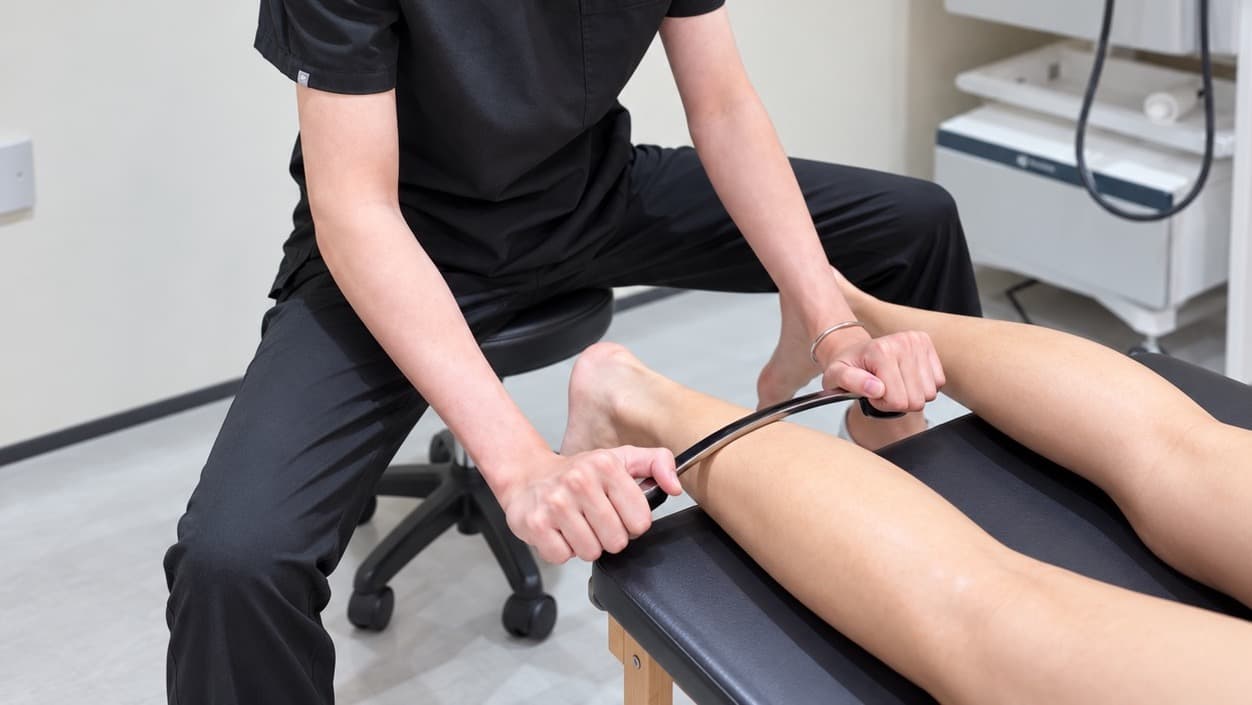
What is IASTM?
Instrument-assisted soft tissue mobilisation (IASTM) is a hands-on technique in which the clinician uses a smooth-edged handheld tool, instead of only the hands, to work over muscles, tendons and the connective tissue (fascia) around them. A little gel or lotion is applied and the tool is stroked along the tissue with controlled pressure.
The tool helps the clinician feel areas that seem thickened or restricted, and lets them treat a precise area. It is often said to "break down adhesions", but that idea is not well proven. Research suggests IASTM may instead help through its effects on how sensitive the tissue and nervous system are, which can make movement feel easier for a while. That short-term window is then used for stretching and strengthening exercise.
What it may help with
- Stiffness and restricted movement in muscles and fascia
- Tendon pain such as tennis elbow, golfer's elbow and Achilles tendinopathy
- Plantar fasciitis and calf tightness, including after a calf strain
- Outer-thigh and knee pain in runners, such as iliotibial band syndrome (see our running injuries guide)
- Tightness around healed scar tissue
A systematic review found IASTM may improve range of movement in the short term, while evidence on pain and function is more limited. It works as part of a plan that includes exercise, not on its own.
What happens in a session
- Assessment first – your clinician examines you and decides whether IASTM is suitable.
- Preparation – gel or lotion is applied to the skin over the area.
- Treatment – the instrument is stroked along the muscle or tendon. Pressure is adjusted to what you can comfortably tolerate; you may feel a scraping or warm sensation.
- Afterwards – treatment usually moves straight on to stretching or exercise for the same area.
IASTM usually takes around 15 minutes of your appointment.
How many sessions?
IASTM is often used over a few visits while you build up your exercise programme, and your clinician will review whether it is helping. Outcomes vary from person to person.
Who provides it
IASTM is offered by all three of our clinicians: HCPC-registered physiotherapists Tim Tsui and Julius Cheuk Chung, and GCC-registered Dr Lok Sze Candice Wong (Chiropractor). See our team.
Cost
IASTM is an add-on treatment: it is added to an initial assessment or follow-up visit and cannot be booked on its own. The add-on price is on our fees page.
Safety and who it may not suit
IASTM is generally well tolerated. Redness of the skin is expected and usually fades within hours; small bruise-like spots and tenderness for a day or two can occur. It is avoided or adapted:
- over broken, inflamed or infected skin, or skin conditions at the area
- if you have a bleeding disorder or take blood-thinning (anticoagulant) medication
- over varicose veins, or an area with a suspected blood clot
- on fragile or thin skin
- over a recent injury, fracture, unhealed scar or area of significant swelling
- during pregnancy over the abdomen and lower back
Your clinician will screen for these before treatment.
Insurance
IASTM is usually given as part of a physiotherapy or chiropractic session, and policies differ in what they cover. Please check with your insurer and check with us before you book.
Sources: Cheatham et al. 2016 – the efficacy of IASTM: a systematic review (J Can Chiropr Assoc)
Frequently asked questions
- Does IASTM hurt?
It can feel like firm scraping pressure and may be mildly uncomfortable over sensitive areas. Pressure is adjusted to what you can tolerate, and redness afterwards is normal.
- Will IASTM leave bruises?
Redness usually fades within hours. Some people get small bruise-like spots or tenderness for a day or two. Tell your clinician if you bruise easily or take blood-thinning medication.
- What is 筋膜刀?
筋膜刀 is the Chinese name commonly used for IASTM. It describes the same technique: a smooth-edged tool used over muscles and fascia, followed by exercise.
- Can I book IASTM on its own?
No. IASTM is an add-on that is added to an initial assessment or follow-up visit after your clinician has checked it is suitable. See our fees.
- Is IASTM covered by insurance?
It is usually given within a physiotherapy or chiropractic session, and policies differ. Please check with your insurer and check with us before you book.
This page is general information, not a diagnosis. A clinician will assess you before recommending any treatment. Outcomes vary from person to person. Read our full disclaimer