
Core treatments
Joint Injection Therapy
Landmark-guided joint injections for persistent joint pain that has not settled with conservative treatment — hyaluronic acid or a prescribed anti-inflammatory injection, decided at assessment.
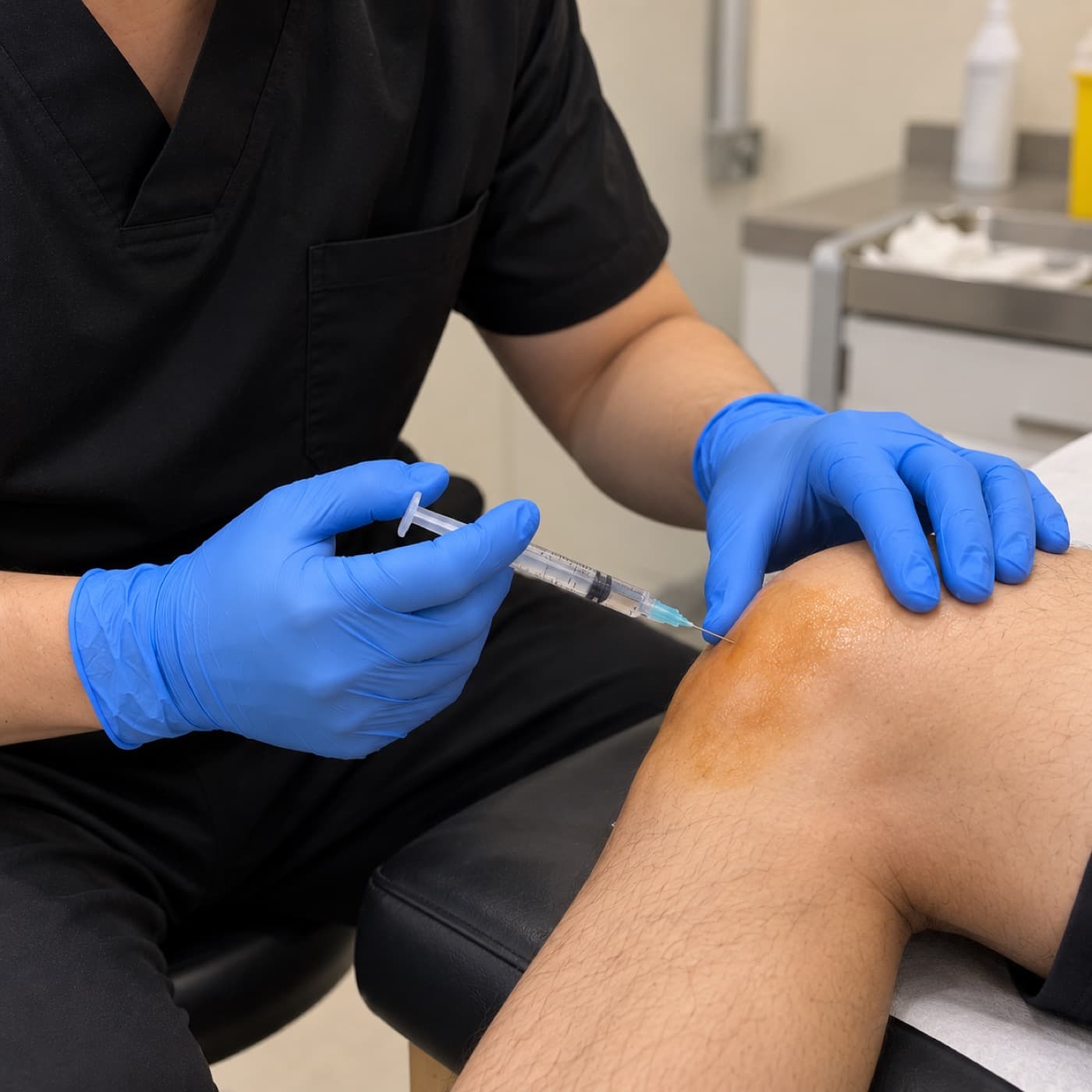
What is joint injection therapy?
Some joint problems — osteoarthritis of the knee, shoulder, elbow or thumb, frozen shoulder, or stubborn bursitis — do not settle with exercise and hands-on treatment alone. In these cases an injection into or around the joint may help reduce pain and inflammation enough to let rehabilitation progress. An injection is not a stand-alone answer: the aim is to create a window in which exercise and everyday activity become easier.
At UK Pain Clinic, injections are landmark-guided: the clinician locates the injection site using anatomical landmarks found by examination and touch, rather than ultrasound guidance. Injections are given only by Mr Tim Tsui, our physiotherapist trained in landmark-guided injection, after an assessment.
Which joints we inject
Our joint injection clinic in Bloomsbury injects only at sites where landmark guidance is a mainstream approach, in line with published clinical reviews such as the American Academy of Family Physicians (AAFP) review of joint and soft tissue injections:
- Knee – into the knee joint
- Shoulder – the glenohumeral (main shoulder) joint, the subacromial space and the acromioclavicular (AC) joint
- Elbow – for example around the outer or inner elbow tendons, or the olecranon bursa at the point of the elbow
- Wrist and hand – the base of the thumb, de Quervain's tenosynovitis, trigger finger and carpal tunnel
- Bursae – the outer hip (trochanteric) bursa, the pes anserine bursa on the inner side of the knee and the bursa at the front of the kneecap
- Foot – Morton's neuroma and, in some cases, the big toe joint
The evidence is stronger for some conditions, such as frozen shoulder, de Quervain's tenosynovitis and trigger finger, and more limited for others. The evidence for hyaluronic acid is limited and mainly concerns knee osteoarthritis. Your clinician will explain what it shows for your own problem.
Two types of injection
- Prescribed anti-inflammatory injection – used for flare-ups of joint or soft-tissue inflammation. This involves a prescription-only medicine, so it is not something we advertise or book directly: whether it is appropriate for you is decided with a doctor after your assessment.
- Hyaluronic acid injection – a lubricating gel injected into osteoarthritic joints (most commonly the knee) that may help ease pain and stiffness for several months in some people.
Your clinician will explain which option, if either, is suitable for your problem, and what the evidence does and does not show for it.
What it may help with
- Knee osteoarthritis
- Elbow osteoarthritis
- Shoulder osteoarthritis and frozen shoulder
- Shoulder impingement and AC joint pain
- Thumb base osteoarthritis, de Quervain's tenosynovitis and trigger finger
- Morton's neuroma
- Bursitis, for example outer hip pain or pes anserine bursitis at the knee
An injection is usually considered when pain has persisted despite a reasonable trial of exercise and other conservative treatment, or when pain is stopping rehabilitation from moving forward.
What happens at your appointment
- Assessment first – an initial assessment to confirm the diagnosis and that an injection is appropriate. If imaging would change the decision, we can arrange an X-ray or MRI.
- Discussion and consent – we go through the likely benefits, the risks and the alternatives (including not having an injection), and you give written consent.
- The injection – the skin is cleaned, the site is located by anatomical landmarks and the injection is given. This is usually a short appointment.
- Aftercare – you will be advised to take things relatively easy for the next few days and given guidance on what to watch for.
- Follow-up – a review of your response and a plan to continue rehabilitation. Injections tend to work better as part of a plan than on their own.
How many injections?
Often a single injection is enough to see whether it helps. Your response is reviewed at follow-up, and a repeat injection is considered only if it is appropriate and the first one helped — there are limits on how often the same joint should be injected. Some people notice a change within days, others over several weeks, and some do not notice much benefit. Outcomes vary from person to person.
Who provides it
Joint injections at our clinic are provided only by Mr Tim Tsui, our physiotherapist. Tim is registered as a physiotherapist in the UK and Hong Kong, holds a Level 7 qualification in Musculoskeletal Injection Therapy from the University of Hertfordshire, and also performs joint injections in the NHS. He speaks English, Cantonese and Mandarin.
Cost
Joint injection therapy follows an initial assessment and is not booked as a first appointment. The current price is on our fees page.
Safety and who it is not suitable for
Injections are not suitable for everyone. We will not inject, or will first arrange a review with a doctor, if you:
- have an infection in or near the joint, or feel generally unwell with a fever
- have diabetes that is not well controlled
- take some blood-thinning medicines or have a bleeding disorder
- have had an allergic reaction to an injection before
- are pregnant or breastfeeding
- have had recent surgery on, or a replacement of, that joint
We screen for all of these at your assessment.
Possible side effects. Most people have no problems, but possible effects include a temporary increase in pain for a day or two (a post-injection flare), bruising and — rarely — infection in the joint. If the joint becomes hot, red and increasingly swollen, or you develop a fever after an injection, call us straight away for a same-day review; if you feel very unwell, go straight to A&E. Call 999 for life-threatening signs such as difficulty breathing or swelling of the face or throat.
Insurance
Some policies cover joint injections and some do not, and your insurer decides on cover and pre-authorisation. Please check with your insurer and check with us before you book.
Sources: NHS – Osteoarthritis treatment · NICE NG226 – Osteoarthritis in over 16s · AAFP – Joint and Soft Tissue Injections (2023)
Frequently asked questions
- Does a joint injection hurt?
Most people describe a sharp scratch and a brief feeling of pressure. The injection itself takes only a short time, and some people have a temporary increase in pain for a day or two afterwards.
- Can I book a joint injection directly?
No. Your first visit needs to be an initial assessment to confirm the diagnosis and check that an injection is appropriate. Whether a prescribed anti-inflammatory injection is suitable is decided with a doctor after that assessment.
- How long does the effect last?
It varies. Some people notice relief for weeks or months, others very little. Outcomes vary, which is why we review your response at follow-up and continue rehabilitation alongside it.
- Who gives the injections?
Only Mr Tim Tsui, our physiotherapist trained in landmark-guided injection, after an assessment. He holds a Level 7 qualification in Musculoskeletal Injection Therapy from the University of Hertfordshire. Injections are landmark-guided rather than ultrasound-guided.
- Is a joint injection covered by insurance?
Some policies cover it and some do not, and your insurer decides on pre-authorisation. Please check with your insurer and check with us before you book.
This page is general information, not a diagnosis. A clinician will assess you before recommending any treatment. Outcomes vary from person to person. Read our full disclaimer